Ways of learning: what the school words mean
School websites use many special words. Reggio Emilia. Montessori. IB. Inquiry. Synthetic phonics.
Often they name the method, but they do not explain it.
This page explains each one in simple words. It shows what you will see in the room.
It also gives you questions to ask on a school visit.
1. The big ways of learning
These are the main methods you will meet in Singapore. Each one has its own idea about how a child learns.
Reggio Emilia
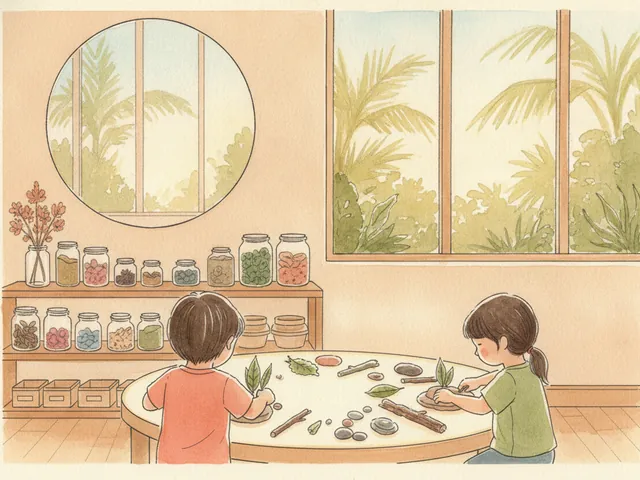
Children follow their own questions in long projects. The room is like a third teacher.
Where it comes from: From the town of Reggio Emilia in Italy, after 1945. A teacher called Loris Malaguzzi led it, with the parents of the town.
The big idea
- Every child is strong and full of ideas.
- A child can show ideas in a hundred ways: drawing, clay, building, music, words.
- Reggio is a way of thinking, not a fixed list of lessons.
What you will see
- Bright, open rooms with real and natural things: leaves, stones, wood, light.
- An art studio called the atelier.
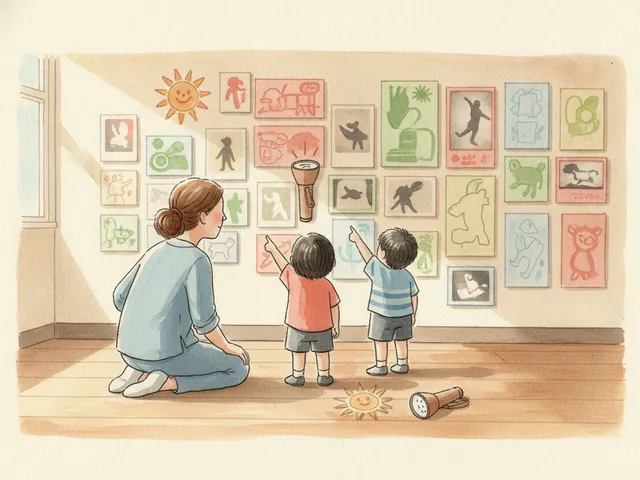
- Walls full of photos and the children's own words. This is called documentation.
- Projects that can last weeks or months, about a question the children asked.
- Teachers who watch, listen and ask questions more than they talk.
- Marks and rewards
- No grades and usually no stickers. Teachers show progress with photos, notes and children's work.
- Ages
- Mostly 0 to 6.
- A common mistake
- Only the schools in the town of Reggio Emilia are truly Reggio. Other schools say "Reggio-inspired". This is correct and honest.
💬 Ask the school
- Can I see the documentation of a recent project? How long did it last?
- Who chose the project: the children or the teacher?
- Is there an atelier? How often do the children use it?
Schools in Singapore that say they use it
- EtonHouse pre-schools · Reggio-inspired. Singapore partner of the Reggio Children network.
- Odyssey The Global Preschool · Reggio-inspired since 2008, with IB PYP.
- Singapore American School, Early Learning Center · Reggio-inspired, project-based.
- Australian International School · Reggio-inspired early years, with IB PYP.
Each school says this on its own website. Tap a name to read it.
🗺️ See these schools on the map: Reggio EmiliaSources: Reggio Children
Montessori
Children choose their own work from special materials, at their own speed.
Where it comes from: From Rome, Italy. Doctor Maria Montessori opened her first school on 6 January 1907.
The big idea
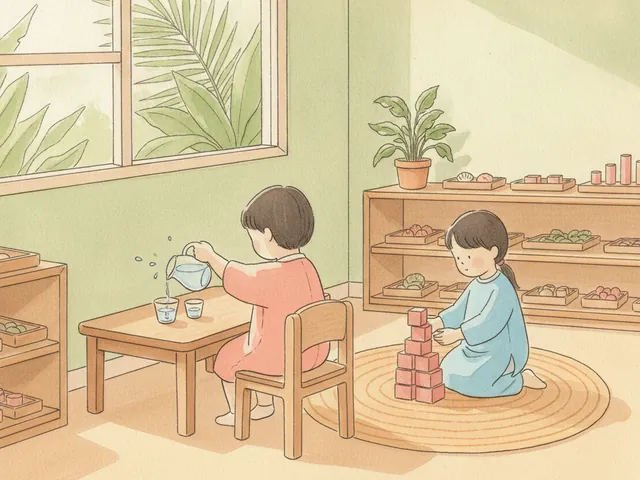
- The room is ready for the child. Everything is at child height.
- Each material teaches one thing. The child can see their own mistakes.
- The child chooses the work. The teacher shows how, then steps back.
What you will see
- Low shelves with wooden materials in a fixed order.
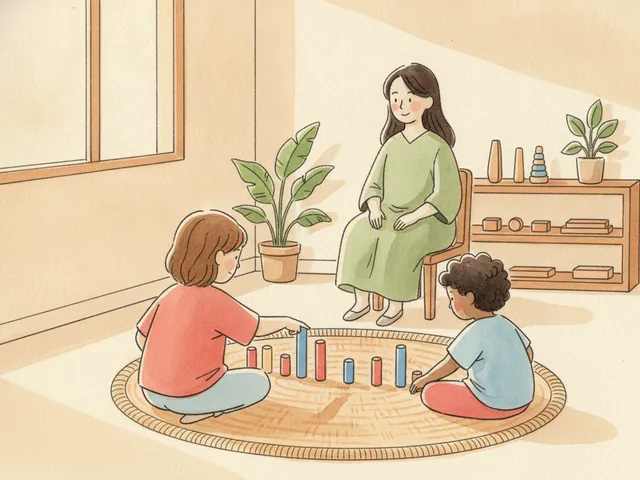
- Mixed ages in one class, for example 3 to 6 years.
- A long, quiet work time in the morning. Often 3 hours.
- Real tasks: pouring water, washing a table, cutting fruit. This is called practical life.
- Children working alone or in twos, on small mats.
- Marks and rewards
- Montessori says no to stickers, prizes and punishment. The joy of the work is the reward.
- Ages
- From babies to 12, sometimes older. Most often 3 to 6.
- A common mistake
- "Children do whatever they want." No. They choose from work the teacher has shown them. The name "Montessori" is not protected, so quality is very different between schools.
💬 Ask the school
- Are the lead teachers trained by AMI or AMS? These are the two big Montessori bodies.
- How long is the morning work time?
- Are the classes mixed-age? Which ages?
Schools in Singapore that say they use it
- Montessori Children's House · Since 1989. AMI-trained teachers.
- Inno Montessori · Says it is AMS-verified.
- Lodestar Montessori School · Montessori for ages 6 to 18, with AMI-trained guides.
Each school says this on its own website. Tap a name to read it.
🗺️ See these schools on the map: MontessoriSources: AMI: the first Casa dei Bambini · AMI standards
IB Primary Years Programme (PYP)
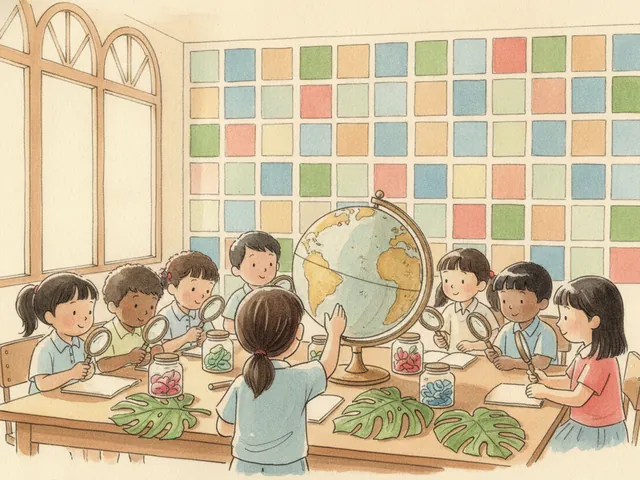
Children learn by asking big questions. One topic joins many subjects.
Where it comes from: From the International Baccalaureate in Geneva, Switzerland. The PYP started in 1997.
The big idea
- Children learn through inquiry. Inquiry means: ask, look for answers, then share.
- Topics are called units of inquiry. Each one joins science, language, art and more.
- Children help to choose and plan their learning. The IB calls this agency.
- For ages 3 to 6, play is at the centre.
What you will see
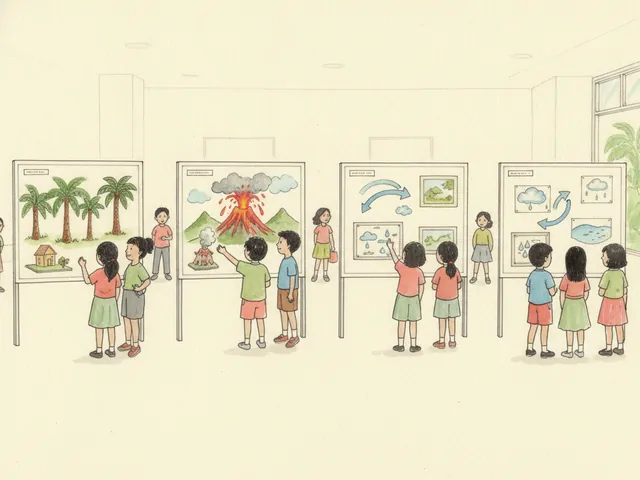
- A wall with the unit question and the children's questions.
- Words like "Inquirer", "Thinker" and "Caring". These are the IB learner profile.
- Group work and talk, not only sitting at desks.
- In the last primary year, a big project called the Exhibition.
- Marks and rewards
- Mostly no marks in the early years. Teachers keep a portfolio. Children often lead the parent meeting.
- Ages
- 3 to 12. After that comes the MYP (11 to 16) and the Diploma (16 to 19).
- A common mistake
- "IB has its own phonics and maths." No. The PYP is a frame. Each school chooses its own reading and maths programmes. Always ask which ones.
💬 Ask the school
- Which phonics and maths programmes do you use inside the PYP?
- Are you an IB World School, or a candidate school?
- How do you report my child's progress?
Schools in Singapore that say they use it
- EtonHouse Nature Pre-School · IB World School since 2015, on the IB's own list.
- Chatsworth International School · IB PYP from kindergarten. Inquiry and play.
- Canadian International School · IB PYP from Pre-K.
- Stamford American International School · IB PYP with American standards.
Each school says this on its own website. Tap a name to read it.
🗺️ See these schools on the map: IBSources: IB: key facts about the PYP · IB: the learner
British Early Years (EYFS)
Clear goals for each age, learned through play in many corners. Then Year 1 at age 5.
Where it comes from: From England. The government wrote it. It started in 2008 and was updated in 2021 and 2023.
The big idea
- It covers birth to age 5.
- There are 7 areas of learning. Three come first: talking and listening, body and movement, and feelings and friends.
- Then: reading and writing, maths, the world around us, and art and music.
- At the end of Reception, there are 17 goals for each child.
What you will see
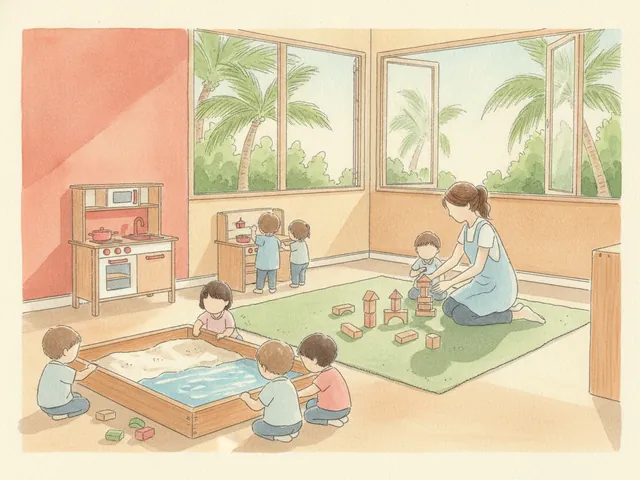
- Many corners that are open all day. The British call this continuous provision.
- Sand and water, a home corner, building blocks, a book corner, paint and playdough.
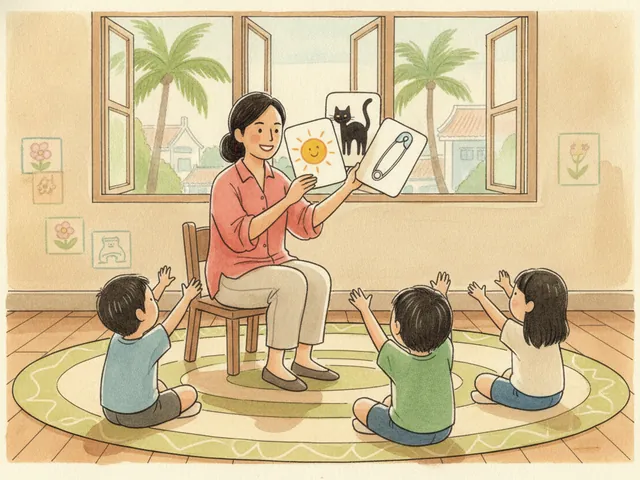
- Short phonics lessons every day in Reception (age 4 to 5).
- Classes by age: Nursery (3 to 4), Reception (4 to 5), then Year 1.
- Marks and rewards
- Stickers, stars and a "star of the week" are common. It depends on the school.
- Ages
- Birth to 5. Then the English National Curriculum from Year 1.
- A common mistake
- "EYFS is only play." It is play with clear goals. Teachers check each child against the goals.
💬 Ask the school
- Which phonics programme do you use, and when does it start?
- How is a day in Year 1 different from Reception?
- Do you check phonics at the end of Year 1, like schools in England?
Schools in Singapore that say they use it
- Tanglin Trust School · EYFS, then the English National Curriculum. Also Forest School.
- Dulwich College (Singapore) · EYFS from Toddler to Reception. English and Mandarin.
- Dover Court International School · EYFS with Reggio ideas.
Each school says this on its own website. Tap a name to read it.
🗺️ See these schools on the map: British and CambridgeSources: EYFS statutory framework (2023)
International Early Years and Primary Curriculum (IEYC and IPC)
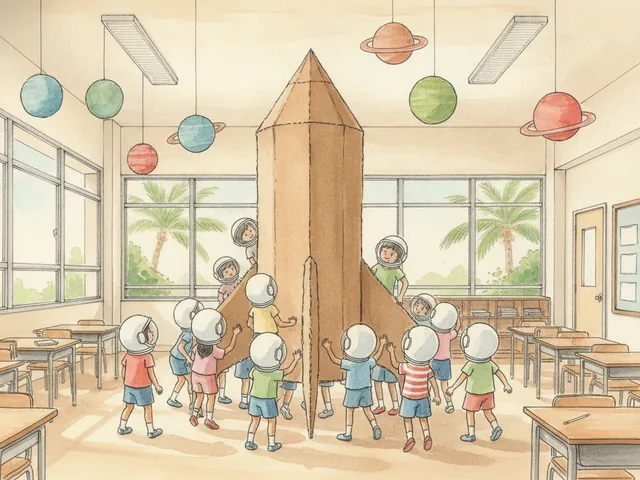
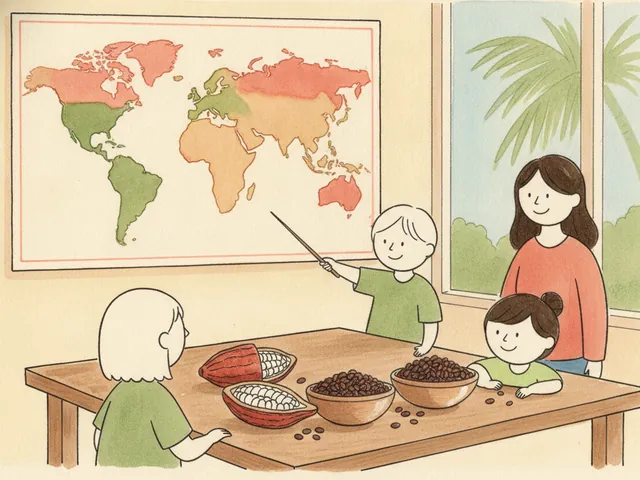
Learning in themes. One theme joins history, science, art and more.
Where it comes from: From Fieldwork Education in the United Kingdom.
The big idea
- The IEYC is for ages 2 to 5. The IPC is for ages 5 to 11.
- Each unit is a theme, like "Chocolate" or "Space".
- A unit follows the same steps: start with a big event, learn, then share.
What you will see
- A big start day for each new theme.
- Theme work that joins many subjects.
- English and maths often taught on their own, often the British way.
- Marks and rewards
- Depends on the school.
- Ages
- 2 to 11. The IMYC follows for ages 11 to 14.
- A common mistake
- "IPC replaces English and maths." No. Most schools teach those on their own, next to the themes.
💬 Ask the school
- Which theme is running now?
- How do the themes link to English and maths?
- How do you check progress?
Schools in Singapore that say they use it
- Overseas Family School · IEYC in kindergarten, then IPC. Jolly Phonics.
- St. Joseph's Institution International · IPC in elementary.
- Middleton International School · IPC in primary, after Reggio-inspired early years.
Each school says this on its own website. Tap a name to read it.
🗺️ See these schools on the map: International Primary (IPC)Sources: British Council: IEYC
Singapore kindergarten (NEL) and MOE primary
Singapore's own plan for ages 4 to 6, with purposeful play. Then MOE primary school.
Where it comes from: From Singapore's Ministry of Education (MOE). Written in 2003, updated in 2012 and 2022.
The big idea
- NEL means Nurturing Early Learners. It is for K1 and K2.
- It has 5 learning areas. They are art and music, the world, health and movement, language, and numbers.
- Values and good habits sit in the middle of all of them.
- Teachers guide. Children build their own understanding through play.
What you will see
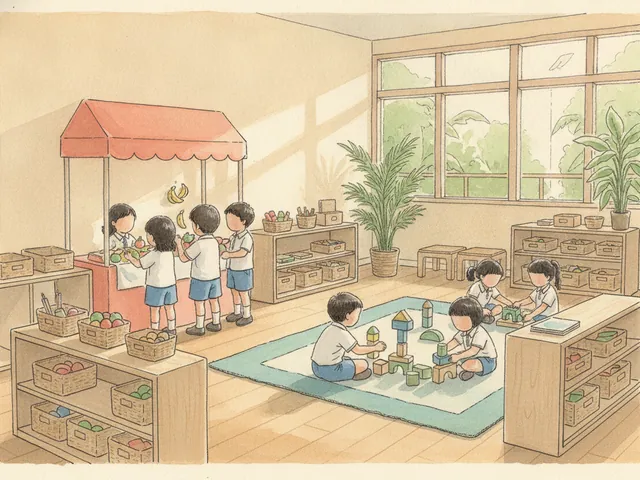
- Learning centres in the classroom: reading, drama, science.
- English and a Mother Tongue language every day.
- Themes that join several areas.
- Marks and rewards
- Depends on the centre. In Primary 1 and 2, there are no exams and no marks since 2019.
- Ages
- NEL: 4 to 6. MOE primary: 7 to 12.
- A common mistake
- "Local kindergarten is only drills." The NEL plan asks for play and hands-on learning.
💬 Ask the school
- How does your programme follow NEL 2022?
- How do you get children ready for Primary 1 English and Mother Tongue?
- How much of the day is play?
Schools in Singapore that say they use it
- MOE Kindergarten · The Ministry's own kindergartens. NEL 2022.
- My First Skool · NEL. Learning corners and an afternoon nap.
- PCF Sparkletots · NEL for kindergarten.
Each school says this on its own website. Tap a name to read it.
🗺️ See these schools on the map: Singapore (MOE)Sources: MOE: the NEL framework · MOE: no exams in P1 and P2
American
Learning centres in Pre-K, then clear standards for reading and maths from Kindergarten.
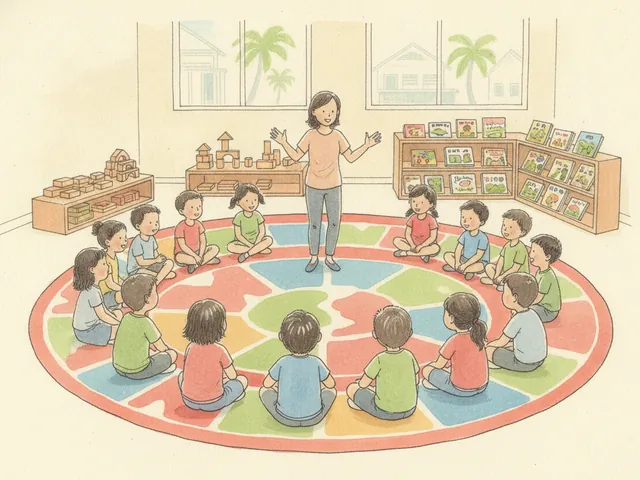
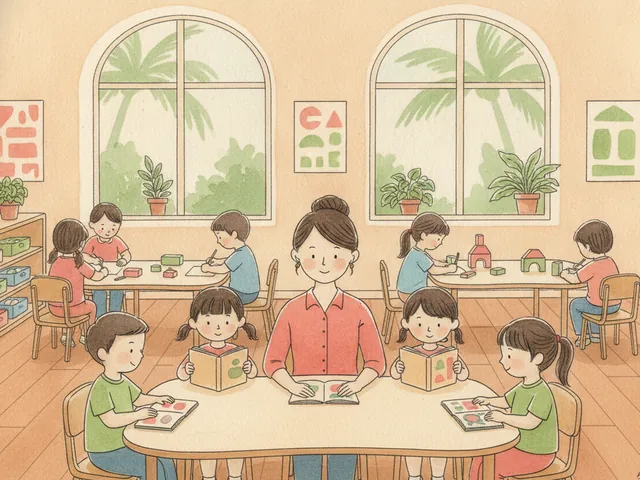
Where it comes from: From the United States. Many schools follow the Common Core or similar standards.
The big idea
- Standards say what a child should know in each grade.
- A standard is a goal, not a book. Each school picks its own programmes.
- Kindergarten (age 5 to 6) already has clear phonics goals.
What you will see
- Learning centres in Pre-K and Kindergarten.
- Grades by age: Pre-K, Kindergarten, then Grade 1.
- In many schools today: a structured phonics programme.
- Marks and rewards
- Praise and class rewards are common. It depends on the school.
- Ages
- From Pre-K (3 to 4) to Grade 12.
- A common mistake
- "American schools let children guess words." Many did. Now many states ban guessing from pictures. Ask what your school does.
💬 Ask the school
- Which reading programme do you use from Kindergarten to Grade 2?
- Do you teach children to guess words from the picture?
- How do you report progress in the first years?
Schools in Singapore that say they use it
- Singapore American School · American, with a Reggio-inspired Early Learning Center.
- Stamford American International School · American standards with IB PYP. Heggerty and UFLI for reading.
Each school says this on its own website. Tap a name to read it.
🗺️ See these schools on the map: AmericanSources: Common Core: Kindergarten reading
Waldorf (Steiner)
A calm daily rhythm, free play and natural toys. Letters come later, at about 7.
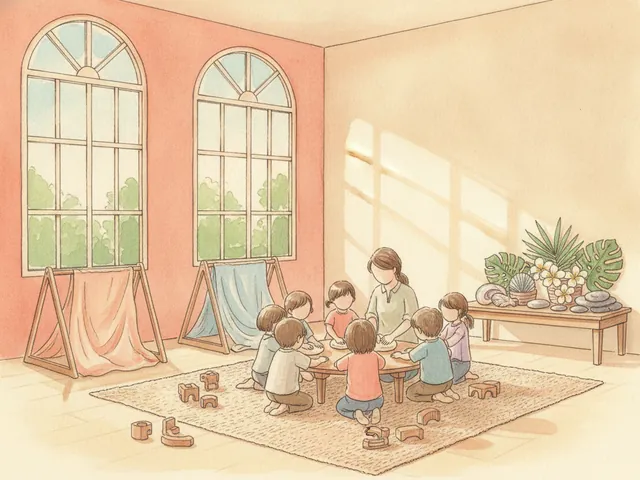
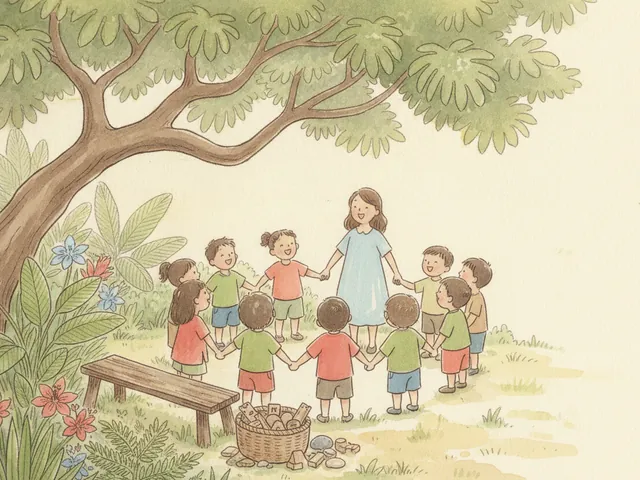
Where it comes from: From Stuttgart, Germany. Rudolf Steiner opened the first school in 1919.
The big idea
- Young children learn by copying adults and by free play.
- The day and the week have a fixed rhythm: a baking day, a painting day.
- Reading and writing start later, at about 6 or 7.
What you will see
- Toys of wood, wool and cotton. Soft colours. Few plastic toys.
- Songs, stories and circle time.
- A long time outside every day.
- No screens in the early years.
- Marks and rewards
- No grades in the early years. Later, teachers write reports.
- Ages
- Kindergarten from about 3. School to 18 in some countries.
- A common mistake
- "Children do not learn to read." They do. They start later, from Class 1.
💬 Ask the school
- When and how do you start letters?
- What if my child moves to another school at 6?
- What is your rule on screens?
Schools in Singapore that say they use it
- Waldorf Steiner Early Years Centre · Run by the Waldorf Steiner Education Association.
- The Straits Waldorf School · International Waldorf curriculum.
Each school says this on its own website. Tap a name to read it.
Sources: History of Waldorf schools
Forest School and nature learning
Regular time in nature, in all weather. Children climb, dig, build and take safe risks.
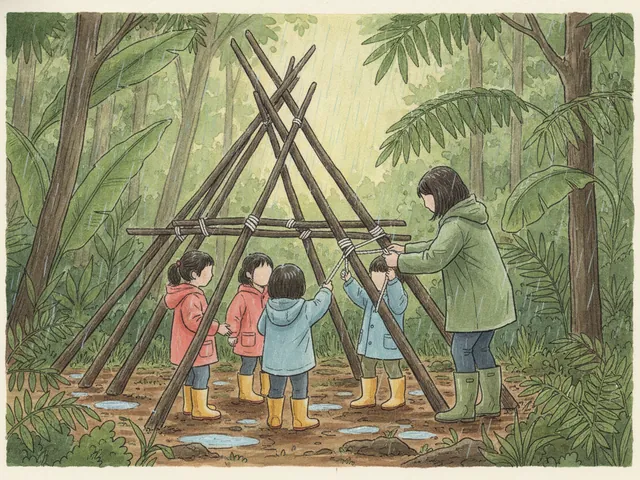
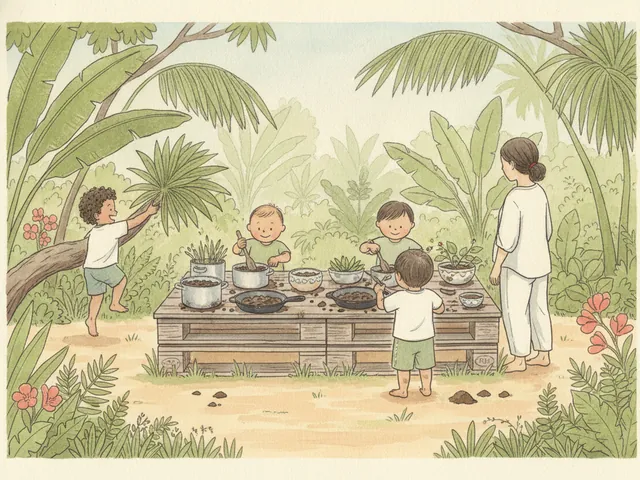
Where it comes from: From the forest kindergartens of Denmark. Teachers from England visited in 1993 and brought it home.
The big idea
- It happens often and for a long time, not one trip.
- It happens in a natural place, like a wood or a garden.
- Children take small, safe risks. This builds confidence.
- The leader has a special Forest School training.
What you will see
- Mud, sticks, tools, dens and a mud kitchen.
- Sessions in rain and sun.
- Many adults for each child.
- Marks and rewards
- No rewards. The goal is confidence and joy.
- Ages
- All ages. In Singapore it is often one session a week, added to another method.
- A common mistake
- "A trip to the park is Forest School." No. Forest School means many sessions, again and again, with a trained leader.
💬 Ask the school
- Does the leader have a Forest School qualification?
- How often are the sessions? Do they go out in the rain?
- Which risks may children take, like climbing or using tools?
Schools in Singapore that say they use it
- Odyssey Forest School, Dempsey · Forest school with Reggio ideas.
- Nurtured Nest · Reggio and Forest School. Outdoors every day.
- Tanglin Trust School · Forest School in the Infant School.
Each school says this on its own website. Tap a name to read it.
Sources: Forest School Association: history
HighScope
Every day, the child plans, does, then talks about it: plan, do, review.
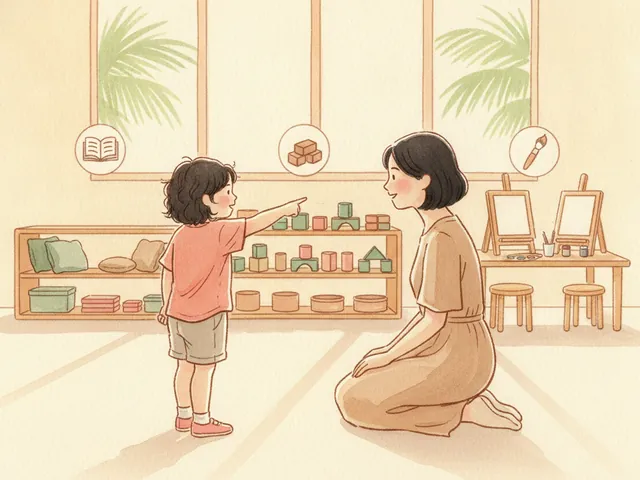
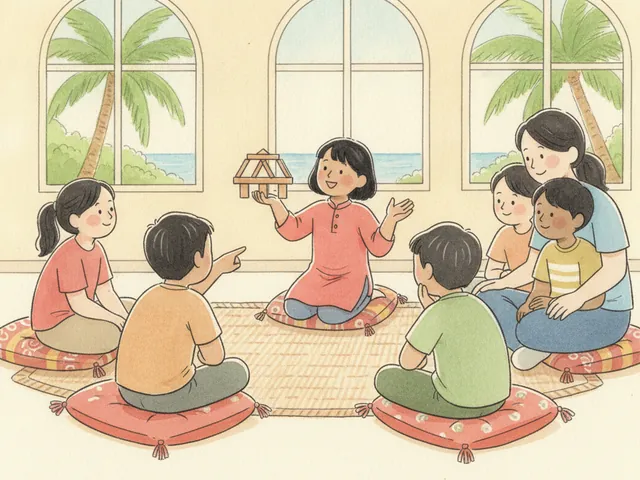
Where it comes from: From Michigan, USA, in 1962. A long study followed the children to age 40.
The big idea
- Children learn best when they act, not only listen.
- Each day has plan time, work time and review time.
- Teachers write down what they see, to follow each child.
What you will see
- Corners with clear labels and pictures.
- A child telling the teacher: "First I will build a bridge."
- The same daily routine, so children feel safe.
- Marks and rewards
- Encouragement instead of prizes.
- Ages
- Mostly 0 to 5.
- A common mistake
- HighScope is rare in Singapore. But its plan-do-review idea is in many classrooms.
💬 Ask the school
- Can I watch plan, do, review?
- How do you share your notes about my child?
- Are the teachers trained in HighScope?
Sources: HighScope: the Perry Preschool study
2. Learning to read: the kinds of phonics
Phonics means: letters stand for sounds. All good schools teach it. But they teach it in very different ways.
Phonics on a path (systematic synthetic phonics)
Sounds first, in a fixed order. Children blend sounds into words from the first weeks.
How it works
- Children learn about 4 sounds a week, in a set order.
- The first sounds are often s, a, t, p, i, n. With them you can read sat, pin and tap.
- Children blend sounds to read: c-a-t, cat.
- They split words into sounds to spell: d-o-g.
- Reading books use only the sounds the child knows. These are called decodable books.
- Some words do not follow the rules. They are taught on their own, as tricky words.
Programmes: Jolly Phonics (42 sounds in 7 groups), Little Wandle, Read Write Inc., Letterland, UFLI.
Who uses it: British schools, many IB schools, and more and more American schools. Montessori uses a sounds-first way too.
Analytic phonics
Start from whole words, then find the shared sound.
How it works
- The child sees a group of words: cat, car, cot.
- The teacher asks: what sound do they share at the start?
- Children learn patterns from words they already know.
Programmes: Often part of an older reading scheme.
Who uses it: Some schools, often mixed with other ways.
The traditional way (letter of the week, guessing words)
One letter each week, by its name. Children guess new words from the picture.
How it works
- A, then B, then C: 26 letters in 26 weeks.
- Children learn letter names ("bee") before sounds ("b").
- Children learn many words by sight.
- For a new word, they are told: look at the picture, guess what makes sense.
Programmes: Many older readers with repeated sentences, like "I see a cat. I see a dog."
Who uses it: Many schools in the past. Some schools still do it.
📊 What the research says
- Big studies agree: phonics on a path works best for most children.
- In the USA, the National Reading Panel said so in 2000.
- In England, the Rose Review said so in 2006. Today every English state school uses it. Children are checked at the end of Year 1.
- Since 2021, many American states have stopped the "guess from the picture" way.
- Phonics is not all of reading. Children also need stories, new words and talk.
🧮 And Montessori?
Montessori children trace sandpaper letters and say the sound. Then they build words with a box of letters, called the moveable alphabet. Often they write words before they read them.
💬 How to find out which kind a school uses
- What is the name of your phonics programme?
- How many new sounds do children learn each week?
- Do the reading books use only the sounds my child knows?
- Do you tell children to guess a word from the picture? If yes, ask why.
- How do you help a child who finds reading hard?
Schools that name their phonics programme
- North London Collegiate School Singapore · Read Write Inc.
- Overseas Family School · Jolly Phonics in kindergarten.
- Stamford American International School · Heggerty, then UFLI.
- Odyssey The Global Preschool · Letterland.
Each school says this on its own website. Tap a name to read it.
Sources: National Reading Panel findings · Rose Review (2006) · EEF: phonics · UK government: choosing a phonics programme · AMI: the phonetic approach
3. The learning corners
Most rooms for young children have corners. Each corner is a small place for one kind of play. Each kind of play builds something your child needs later.
Small hands corner
Playdough, tweezers, beads to thread, pegs, scissors.
Why it matters: It makes the small muscles of the hand strong. Your child needs them later to hold a pencil and write.
A big part of: Reggio EmiliaMontessoriBritish EYFSSingapore NELHighScope
Sand and water
Sand, water, cups, funnels, spades.
Why it matters: Children pour, fill and measure. They learn more, less, full and empty. It also calms many children.
A big part of: British EYFSReggio EmiliaIB PYPSingapore NEL
Natural things and loose parts
Leaves, stones, shells, wood, pine cones, fabric.
Why it matters: Open things can become anything. A stone can be a car, a cake or a number. This builds imagination.
A big part of: Reggio EmiliaWaldorfForest School
Home corner and pretend play
A small kitchen, dolls, dress-up clothes, a pretend shop.
Why it matters: Children take turns, talk and play roles. This builds language and friendships.
A big part of: British EYFSSingapore NELAmericanWaldorfHighScope
Building blocks
Wooden blocks, bricks, tubes, ramps.
Why it matters: Children plan, balance and count. It is early maths and early science.
A big part of: British EYFSReggio EmiliaIB PYPAmericanHighScope
Book corner
A soft, quiet place with picture books.
Why it matters: Children hold books, look at pictures and hear stories. This builds new words and a love of reading.
A big part of: British EYFSSingapore NELIB PYPAmericanMontessori
Mark-making and writing
Crayons, chalk, paper, a whiteboard, letters to copy.
Why it matters: First scribbles, then shapes, then letters. Children learn to hold a pencil the right way.
A big part of: British EYFSSingapore NELMontessori
Art studio (atelier)
Paint, clay, wire, light tables, mirrors.
Why it matters: Children show their ideas with their hands. In Reggio, the atelier is the heart of the school.
A big part of: Reggio EmiliaBritish EYFSWaldorf
Practical life
Real jugs, small brooms, buttons to do up, fruit to cut.
Why it matters: Children learn to care for themselves and the room. It builds focus and pride.
A big part of: MontessoriWaldorf
Discovery and science
Magnifying glasses, magnets, plants, small animals.
Why it matters: Children ask why and look closely. They learn cause and effect.
A big part of: IB PYPReggio EmiliaSingapore NELAmerican
Calm corner
Cushions, soft toys, pictures of feelings.
Why it matters: A child who is upset can rest and calm down. They learn to name their feelings.
A big part of: British EYFSIB PYPSingapore NEL
4. A child's day: rest, moving, rewards and fun
The method is not only about lessons. It also shapes nap time, play outside and how teachers praise your child.
Nap and rest
- Singapore's guidelines say: children aged 3 to 5 need 10 to 13 hours of sleep a day. Naps count.
- A study found this: a nap helps young children remember what they learned that morning.
- Most full-day preschools have a rest time after lunch. Children who do not sleep usually rest quietly.
- Reception and Year 1 classes usually have no nap.
💬 Ask: Where do the children sleep? What does a child who does not sleep do?
Sources: Singapore 24-hour activity guidelines for children (KKH) · Naps and memory in preschool children (PNAS, 2013)
Moving and playing outside
- Children aged 3 to 6 need at least 3 hours of movement a day. One hour of it should make them breathe fast.
- Children should not sit still for more than one hour at a time.
- Less than one hour of screen time a day.
- Running and climbing build the big muscles. They also help children sit still and focus later.
💬 Ask: How long are the children outside each day? What do they do when it rains?
Sources: Singapore 24-hour activity guidelines for children (KKH) · WHO: sit less and play more
Rewards: stickers or not?
- Some schools use stickers, stars and prizes. Montessori and Reggio schools usually do not.
- A large review of 128 studies found this: a promised prize can make a child less keen on the task later.
- Kind words about the effort helped children stay keen.
- So many teachers praise the work and the effort: "You tried hard on that tower."
💬 Ask: How do you praise children? How do you handle bad behaviour?
Sources: Deci, Koestner and Ryan (1999): rewards and motivation · Montessori: beyond bribes and rewards
Play and fun
- Play is how young children learn. Every method on this page agrees on that.
- The difference is how much the adult leads the play.
- A review of 17 studies looked at this. Play with a little adult help taught early maths better than lessons alone.
- A happy child who feels safe learns more.
💬 Ask: How much of the day is free play? How much does the teacher lead?
Sources: Guided play vs direct instruction (Child Development, 2022)
5. All methods side by side
This table shows what each method usually does. One school can be different. Always ask.
| Method | Learning corners | Child chooses much of the day | Mixed ages in one class | Natural materials | Stickers and prizes | Long projects | Phonics starts |
|---|---|---|---|---|---|---|---|
| Reggio Emilia | Yes | Yes | Some | Yes | No | Yes | Later (age 6 to 7) |
| Montessori | Yes | Yes | Yes | Some | No | Some | Early (age 4 to 5) |
| IB PYP | Yes | Some | No | Depends | Depends | Yes | Depends |
| British EYFS | Yes | Yes | No | Some | Some | Some | Early (age 4 to 5) |
| IEYC / IPC | Yes | Some | No | Depends | Depends | Yes | Early (age 4 to 5) |
| Singapore NEL | Yes | Some | No | Depends | Some | Some | Early (age 4 to 5) |
| American | Yes | Some | No | Depends | Some | Some | Early (age 4 to 5) |
| Waldorf | Some | Yes | Yes | Yes | No | No | Later (age 6 to 7) |
| Forest School | No | Yes | Depends | Yes | No | Some | Depends |
| HighScope | Yes | Yes | Some | Depends | No | Some | Later (age 6 to 7) |
"Depends" means it is different from school to school.
No method is the best for every child. Visit the school. Watch the children. Ask the questions on this page. A good school is happy to answer them.
Sources: Reggio Children · AMI: the first Casa dei Bambini · AMI standards · IB: key facts about the PYP · IB: the learner · EYFS statutory framework (2023) · British Council: IEYC · MOE: the NEL framework · MOE: no exams in P1 and P2 · Common Core: Kindergarten reading · History of Waldorf schools · Forest School Association: history · HighScope: the Perry Preschool study · National Reading Panel findings · Rose Review (2006) · EEF: phonics · UK government: choosing a phonics programme · AMI: the phonetic approach · Singapore 24-hour activity guidelines for children (KKH) · Naps and memory in preschool children (PNAS, 2013) · WHO: sit less and play more · Deci, Koestner and Ryan (1999): rewards and motivation · Montessori: beyond bribes and rewards · Guided play vs direct instruction (Child Development, 2022) We checked the facts on 5 November 2026.